Automatic press brake
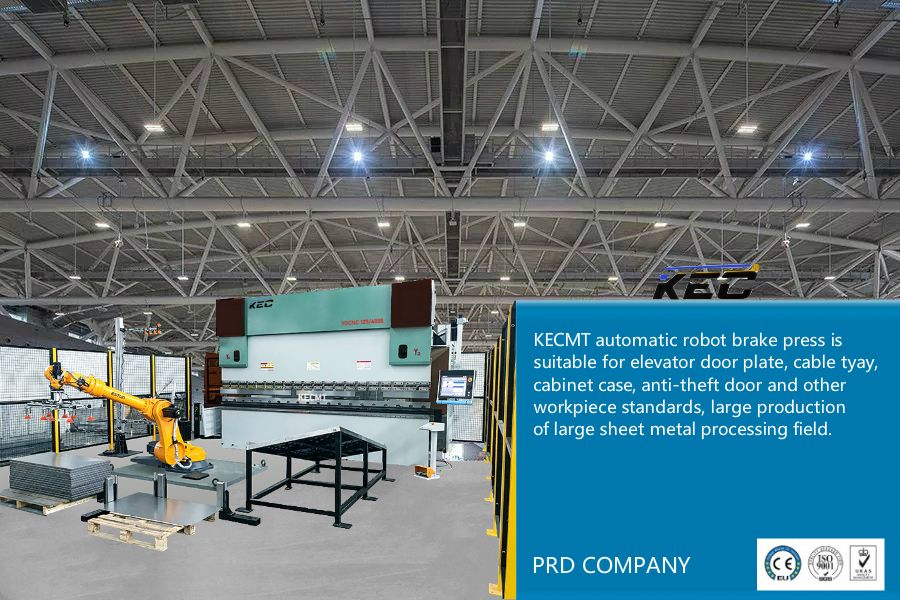
An automatic press brake integrates robotic arms (cobots) with CNC-controlled bending systems to automate complex metal forming tasks. Loading, positioning, bending and unloading all run without an operator at the machine — safely, because the cobot is force-limited where people share the space.
What an automatic press brake with a cobotic arm is
An automatic press brake integrates robotic arms (cobots) with CNC-controlled bending systems to automate complex metal forming tasks. These systems combine hydraulic or electric press brakes with collaborative robots (cobots) for loading, positioning, bending and unloading sheet metal. Key advantages include:
- Precision: cobotic arms achieve ±0.03 mm accuracy using advanced sensors and real-time feedback
- Safety: force-limiting sensors and ISO 9283-compliant designs allow safe human-robot collaboration
- Flexibility: quick tooling changes and adaptive programming enable small-batch production
- Efficiency: 24/7 operation reduces cycle times by 40–50% compared with manual workflows
Cutting-edge specifications
Cobotic arm integration
- Robot model: UR5e-class collaborative robot (6-axis, 6 DoF) with ±0.03 mm repeatability
- Payload: up to 20 kg in dual-arm configurations for handling thick steel plates (up to 20 mm)
- Programming: intuitive touchscreen interfaces with offline simulation (Delem DA66T) reduce setup time
Press brake specifications
- Force range: 40–1,200 tons, supporting materials from 1 mm aluminium to 30 mm steel
- Bending speed: fast approach 300 mm/s (electric servo-driven); bending speed 10–15 mm/s adjustable for precision
- Back gauge system: 6-axis CNC control (X, R, Z) with ±0.1 mm positioning accuracy
Advanced features
- IoT connectivity: real-time monitoring and predictive maintenance reduce downtime
- Tooling compatibility: Trumpf-type tooling ensures seamless integration with existing systems
- Energy efficiency: regenerative braking cuts power consumption by 20–30% compared with hydraulic-only systems
How the cell compares
| Feature | KECMT cobotic cell | Premium-brand automated cells |
|---|---|---|
| Cobot precision | ±0.03 mm | ±0.03–0.05 mm |
| Press brake force | 40–1,200 tons | Comparable mid-range |
| Tooling | Trumpf-type compatible | Often proprietary |
| Programming | Delem DA66T + offline simulation | Vendor software, similar capability |
| Energy | Regenerative, 20–30% saving | Premium hybrid options |
| Service | Direct factory + local distributors | Regional service network |
Comparison based on published specifications of comparable automated bending cells; figures vary by configuration.
When automation pays
The case for automation is built on removing people from repetitive handling, running the second and third shift without an operator at the machine, and cutting the scrap that comes from inconsistent blank presentation. Where the part family is stable and the volume is there, the cell earns its cost. Where the mix is genuinely one-off, we will recommend a manual machine instead — and build you a good one.
Ask about the automatic press brake
Send the part you need to bend and we will come back with a configuration and a quote.