English wheel
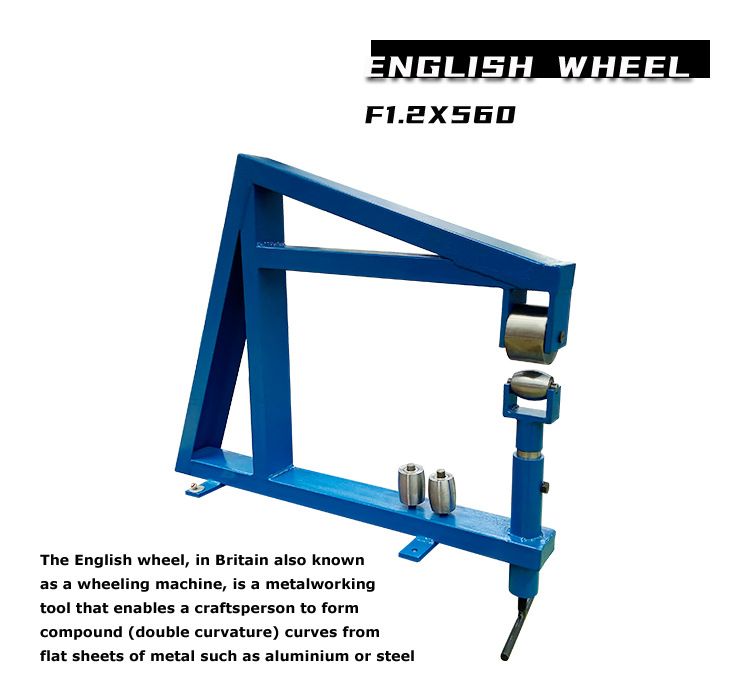
The English wheel — in Britain also known as a wheeling machine — is a metalworking tool that enables a craftsperson to form compound (double curvature) curves from flat sheets of metal such as aluminium or steel. Two contoured wheels apply controlled pressure; the sheet is worked back and forth until the curve grows.
Core mechanics
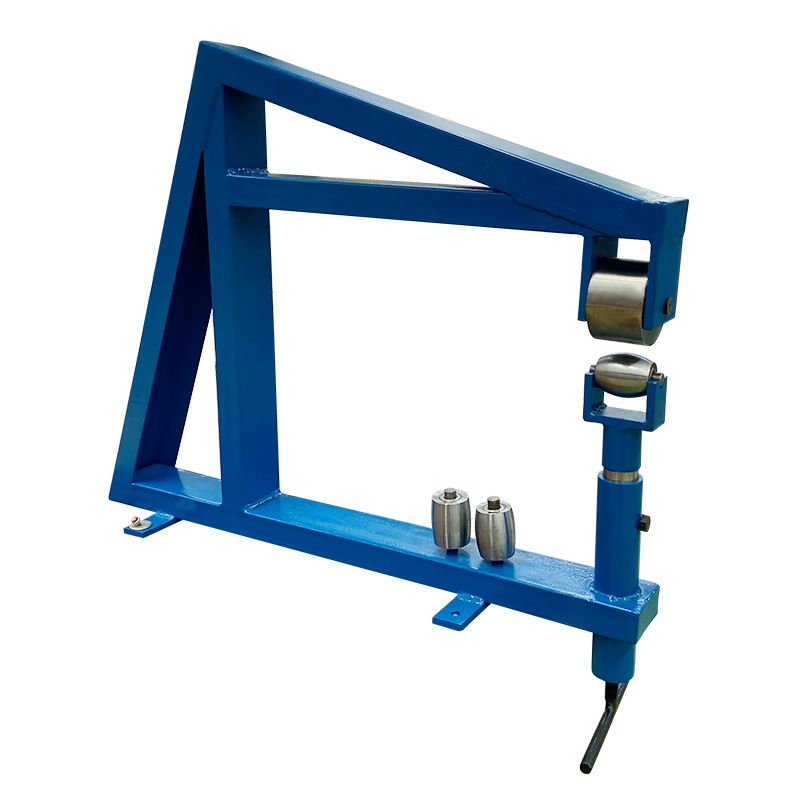
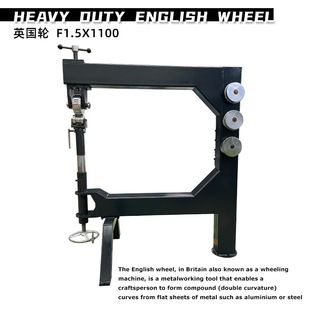
The English wheel operates on the principle of incremental forming, where a pair of contoured wheels — an upper "anvil wheel" and a lower "rolling wheel" — apply controlled pressure to metal sheets. As the sheet passes between the wheels, localised plastic deformation creates smooth curves without compromising material integrity. Key components:
- Frame: typically constructed from high-grade steel (304 stainless) to withstand forces up to 10 tons
- Adjustable pressure system: hydraulic or screw-driven mechanism to modulate force (0.5–15 kN)
- Wheel sets: interchangeable anvil wheels (radius 50–300 mm) and rolling wheels (radius 25–150 mm) for diverse curvatures
Specifications
Structural parameters
- Frame stability: reinforced C-frame design with throat depth of 1,200 mm to accommodate large sheets (2,000 × 1,000 mm aluminium panels)
- Wheel material: case-hardened tool steel (HRC 60–62) or polyurethane-coated wheels for non-marring finishes
- Pressure range: programmable servo-hydraulic system offering 0.1–20 kN force with ±1% repeatability
Performance metrics
- Sheet thickness: 0.5–6 mm for aluminium, stainless steel and titanium alloys
- Surface finish: Ra ≤ 0.8 μm through polished wheels and automated lubrication
- Accuracy: CNC-guided models ensure ±0.05 mm dimensional tolerance for aerospace-grade components
Customisation
- Modular tooling: quick-change wheel mounts for rapid transitions between convex, concave and asymmetric profiles
- Automation integration: compatibility with robotic arms (6-axis robots) for repeatable, high-throughput tasks
- Data-driven calibration: embedded strain gauges and IoT sensors monitor stress distribution and predict tool wear
Advanced applications
- Aerospace prototyping: forming lightweight, aerodynamic panels for drones and satellite housings
- Custom automotive bodies: crafting one-off fenders or hoods with compound curves for luxury vehicles
- Architectural metalwork: curved fascia and cladding panels that no brake can form
- Restoration: repair panels for vehicles where replacements no longer exist
- Art and sculpture: the machine behind most hand-formed metal sculpture
Why the English wheel and not a press brake
A press brake makes a straight bend. A shrinking stretcher, roller or hammer can force a curve, but the English wheel is the only machine that grows a true compound curve from flat sheet with a smooth, controlled surface — no die to make, no pattern to cut. For one-off panels it is the difference between making the part and buying a die to make the part.
Ask about the english wheel
Send the part you need to bend and we will come back with a configuration and a quote.