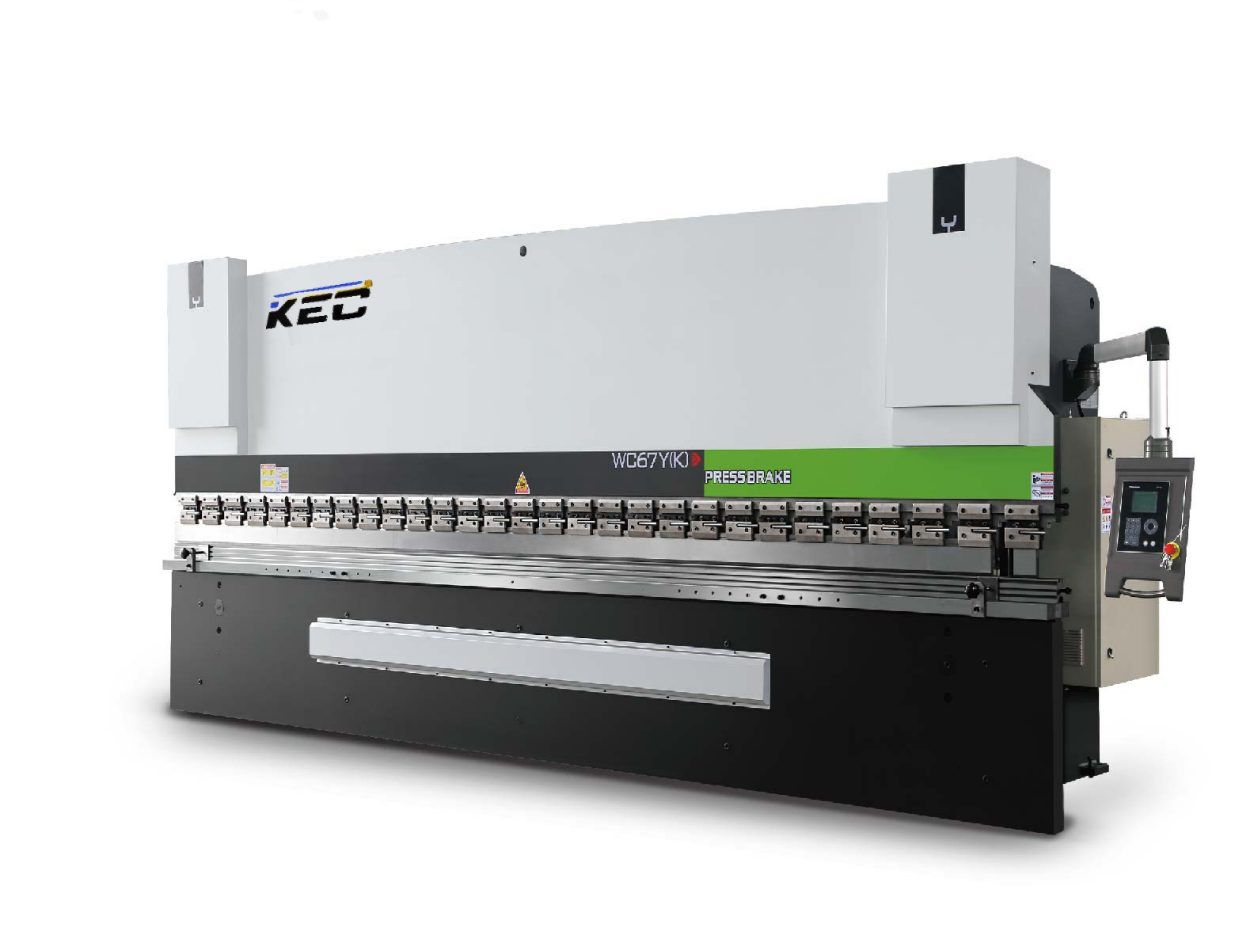
CNC torsion bar press brake
The conventional press brake: two cylinders held in step by a high-strength alloy torsion shaft instead of a servo loop. Mature structure, low failure rate, straightforward maintenance — 22 standard models from 30 to 400 ton.
What this machine is
A torsion bar press brake is the conventional CNC press brake: the ram is driven by two hydraulic cylinders, and instead of a servo loop keeping the two ends aligned, the cylinders are rigidly connected through a high-strength alloy torsion shaft that forces both ends of the ram to run in sync for the entire stroke. The synchronisation is mechanical, always on, and independent of the control system.
We build these in 22 standard models from WC67K-30/1600 to WC67K-400/4000 — 30 to 400 ton nominal pressure across bending lengths from 1.6 to 6 m. Special models with non-standard throat depth and open height are custom-built to order.
Specifications
| No. | Model | Nominal pressure (kN) | Table length (mm) | Between housings (mm) | Throat depth (mm) | Stroke / strokes (mm / spm) | Open height (mm) | Main motor (kW) | Backgauge travel (mm) | Overall LxWxH (mm) |
|---|---|---|---|---|---|---|---|---|---|---|
| 1 | WC67K-30/1600 | 300 | 1600 | 1000 | 200 | 100 / 12 | 240 | 3 | 400 | 2000 x 1200 x 1900 |
| 2 | WC67K-45/2000 | 450 | 2000 | 1675 | 200 | 100 / 11 | 260 | 4 | 500 | 2400 x 1300 x 2000 |
| 3 | WC67K-70/2500 | 700 | 2500 | 2095 | 250 | 120 / 10 | 320 | 5.5 | 500 | 2700 x 1500 x 2200 |
| 4 | WC67K-70/3200 | 700 | 3200 | 2570 | 250 | 120 / 10 | 320 | 5.5 | 600 | 3400 x 1500 x 2200 |
| 5 | WC67K-90/2500 | 900 | 2500 | 2095 | 250 | 120 / 9 | 320 | 5.5 | 600 | 2800 x 1600 x 2300 |
| 6 | WC67K-90/3200 | 900 | 3200 | 2600 | 250 | 120 / 9 | 320 | 7.5 | 800 | 3600 x 1600 x 2300 |
| 7 | WC67K-110/3200 | 1100 | 3200 | 2600 | 300 | 150 / 9 | 380 | 7.5 | 600 | 3400 x 1800 x 2400 |
| 8 | WC67K-110/4000 | 1100 | 4000 | 3100 | 300 | 150 / 9 | 380 | 7.5 | 800 | 4200 x 1800 x 2400 |
| 9 | WC67K-130/3200 | 1300 | 3200 | 2550 | 300 | 150 / 8 | 380 | 7.5 | 600 | 3350 x 1800 x 2450 |
| 10 | WC67K-130/4000 | 1300 | 4000 | 3450 | 300 | 150 / 8 | 380 | 11 | 800 | 4100 x 1800 x 2450 |
| 11 | WC67K-160/3200 | 1600 | 3200 | 2540 | 300 | 160 / 8 | 400 | 11 | 600 | 3400 x 1900 x 2500 |
| 12 | WC67K-170/4000 | 1700 | 4000 | 3140 | 320 | 160 / 7 | 420 | 11 | 800 | 4200 x 2000 x 2600 |
| 13 | WC67K-170/6000 | 1700 | 6000 | 4740 | 320 | 160 / 6 | 420 | 11 | 1000 | 6200 x 2000 x 2600 |
| 14 | WC67K-200/3200 | 2000 | 3200 | 2540 | 320 | 180 / 6 | 450 | 11 | 800 | 3400 x 2100 x 2700 |
| 15 | WC67K-200/4000 | 2000 | 4000 | 3140 | 320 | 180 / 6 | 450 | 15 | 800 | 4200 x 2100 x 2700 |
| 16 | WC67K-200/5000 | 2000 | 5000 | 3940 | 320 | 180 / 5 | 450 | 15 | 1000 | 5200 x 2100 x 2700 |
| 17 | WC67K-250/4000 | 2500 | 4000 | 3120 | 400 | 200 / 5 | 500 | 18.5 | 800 | 4200 x 2200 x 2900 |
| 18 | WC67K-250/5000 | 2500 | 5000 | 3920 | 400 | 200 / 5 | 500 | 18.5 | 1000 | 5200 x 2200 x 2900 |
| 19 | WC67K-250/6000 | 2500 | 6000 | 4720 | 400 | 200 / 4 | 500 | 18.5 | 1000 | 6200 x 2200 x 2900 |
| 20 | WC67K-300/5000 | 3000 | 5000 | 3910 | 400 | 200 / 4 | 520 | 22 | 1000 | 5200 x 2500 x 3200 |
| 21 | WC67K-300/6000 | 3000 | 6000 | 4710 | 400 | 200 / 3 | 520 | 22 | 1200 | 6200 x 2500 x 3200 |
| 22 | WC67K-400/4000 | 4000 | 4000 | 3100 | 400 | 220 / 3 | 560 | 30 | 1000 | 4200 x 2800 x 3500 |
Specifications per the factory catalogue. The above are standard machine models; throat depth and open height can be customized to different production requirements.
Reading the model table
The model number reads as tonnage x bending length — a WC67K-90/3200 bends 90-ton work across a 3.2 m bed. Three things to understand before picking a row:
- Stroke and stroke rate move against each other. Strokes per minute fall from 12 on the smallest model to 3 on the largest, while stroke length grows from 100 to 220 mm. If your work is high-volume thin sheet, stroke rate matters as much as tonnage — a machine one size larger than you need costs you cycle time on every bend.
- Throat depth grows with tonnage. 200 mm on the small models up to 400 mm on the 250–400 ton range. If your parts have flanges that must clear the housing, check throat depth before tonnage — it is the dimension that disqualifies a machine outright.
- Backgauge travel reaches 1200 mm on the long models, so deep flanges can be positioned from the standard fence without fixtures.
Machine structure
The parts of the machine that decide whether it still bends straight in year five:
- Frame. Split steel plates, welded and then stress-relieved in a large tempering furnace to remove the deformation caused by welding and machining stresses — the step that decides whether the machine holds its accuracy over its working life.
- Torsion shaft synchronisation. The left and right main cylinders are rigidly connected through a high-strength alloy torsion shaft that forces both ends of the ram to run in step for the full stroke. Mature structure, low failure rate, simple maintenance — no servo tuning, no drift to correct.
- Hydraulics. An integrated valve block design with Bosch Rexroth hydraulic components: compact structure, low operating noise, stable pressure output and reduced leak risk. The pump is driven directly by a three-phase asynchronous motor — fast power response and strong system stability across all conventional bending scenarios.
- Cylinders. Machined by specialist manufacturers, with the inner bore precision honed, hard-chrome plated and polished, fitted with high-quality sealing rings and standard pipe fittings. High-speed stable operation with leak problems designed out rather than managed.
- Mechanical crowning compensation (option). Compensates for ram and frame deflection during bending, so long sheets come out with consistent angle instead of a taper. The compensation amount is adjusted manually or electrically against the bending parameters.
- Backgauge. The X-axis backgauge is built from left and right guide rail seats, crossbeam, adjusting seats, brackets, adjustable supports, base plates, adjusting lead screws and gauge fingers, driven front-to-back by a dedicated X-axis servo motor. The R-axis backgauge adds a servo motor and reducer, moving the crossbeam up and down along linear guides through gear and rack — so the fence repositions in both axes without the operator handling the sheet.
- Electrics. Main electrical components are Schneider or other established imported and joint-venture brands.
Control system
The standard control is the TP10S, running on a high-resolution 10.1-inch touch screen (1024 x 600):
- Y1/Y2 axis synchronous closed-loop control
- Backgauge multi-axis linkage control, X + R
- Worktable crowning compensation control
- Automatic bending sequence calculation and auxiliary programming
- Tool / material / product process library
- Bending count and program storage, up to 40 program steps
- Panel-mount or pendant-arm installation; controls servo and variable-frequency motors alike
- 24 V DC ±20% supply, 0–50 °C operating range, IP54 protection
Main configuration
| Item | Component | Brand / note |
|---|---|---|
| 1 | Main motor | Huyuan (Shanghai) / Siemens (optional) |
| 2 | Electrical components | Schneider (France) |
| 3 | X, R axis servo motors | Estun / INOVANCE (China) |
| 4 | Servo drives | Estun (China) |
| 5 | Hydraulic valve | Bosch Rexroth |
| 6 | Hydraulic pump | SUNNY (USA) |
| 7 | Oil cylinder | YUKEN |
| 8 | Pipe connectors | EMB |
| 9 | Crowning table | CHNVIKEN (optional) |
| 10 | Punch and die tooling | CHNVIKEN |
| 11 | Quick clamp | CHNVIKEN |
| 12 | Laser protection | DSP (Italy) / LNTECH (China) — optional |
| 13 | Rear light curtain protection | KELI / LNTECH |
Installation, training and after-sales
- Foundation. We provide the foundation drawing; you are responsible for the construction work.
- Shipment notice. When the machine is assembled at our works, we notify you of the shipment schedule and what to prepare for installation.
- Installation and commissioning. Our engineers install and commission the machine at your site, with your cooperation — you provide lifting equipment, water, electricity, hydraulic oil and the necessary conditions.
- Training. During installation and commissioning we train your technical staff free of charge and provide technical consultation. If you need an engineer to travel for debugging, that cost is reimbursed at actuals.
- Acceptance. On completion, both parties inspect and accept the machine jointly against the signed technical agreement and its attachments.
- Warranty. Three-guarantee policy from the date of sale, with a three-year quality guarantee from the date of acceptance. Within the warranty period, component damage not caused by the user is replaced free of charge; wearing parts are excluded. After the guarantee expires, lifetime service continues with parts charged at cost.
Related
- Electro-hydraulic servo press brake — the same 22 models with closed-loop cylinder sync, grating rulers and CNC crowning
- CNC hydraulic press brake — the full range overview and how we configure machines
- Small tonnage press brakes — 220V single-phase machines for small shops
- How much tonnage do you need? — the sizing logic behind the table
- Machine selector tool — answer a few questions and get a recommended configuration
Ask about the cnc torsion bar press brake
Send the part you need to bend and we will come back with a configuration and a quote.